
Managed Services for the areas of IT that need stability and someone to run them responsibly.
We manage selected IT functions, teams or operational areas, so the client’s in-house team can focus on business priorities, product development and strategic initiatives.
Trusted by





Cloud & Infra
We support cloud environments and maintain infrastructure
DevOps & K8s
Pipelines, automation and Kubernetes environments
SLA & KPI
Reporting built on metrics we agree together
Continuity
Operational ownership and backup skills
When your IT team should not be carrying everything alone
Managed Services helps you move from ad hoc support to an orderly operating model.
As technology grows more complex, in-house IT teams increasingly answer for everything at once: infrastructure, cloud, deployments, monitoring, support, automation, security, data flows and application maintenance.
In the Managed Services model, an external team manages a defined area of IT against an agreed scope, agreed responsibilities, agreed reporting and agreed quality metrics.

Before
Ad hoc support, an overloaded in-house team, and no clear ownership of the operational area.
After
A defined scope, a technical lead, reporting, continuity of operations and a backlog of improvements.
What happens when IT operations have no clear owner
The in-house IT team is overloaded with operations
Risk for the client
Strategic work keeps getting postponed, because the key people are busy putting out fires.
How GS Services helps
We take responsibility for selected operational areas.
Cloud or infrastructure keeps growing more complex
Risk for the client
Incidents, manual work and unstable processes slow delivery down.
How GS Services helps
We support cloud, DevOps, Kubernetes and infrastructure operations..
What is needed is ongoing support, not just one consultant
Risk for the client
Staff Augmentation does not solve the problem of ownership and coordination.
How GS Services helps
We set up a Managed Services model with a technical lead.
The company depends on a handful of key people
Risk for the client
Absence, turnover or overload put continuity at risk.
How GS Services helps
We build a managed team with a defined scope and backup capacity.
Reporting and accountability are missing
Risk for the client
It is hard to judge quality, workload, risk and the results of the work.
How GS Services helps
We work to SLAs/KPIs, status reporting and improvement actions.
Not sure whether you need more people or more ownership?
Let’s review the area of IT that weighs most on your team, and check whether Managed Services is the right model.

Selected IT areas managed to fit the client’s operational needs
The scope does not have to cover all of IT.
It can cover a single function, a single technology or a single operational process.

Cloud and infrastructure operations
We support cloud environments and look after infrastructure, availability, configuration and operational stability.

DevOps
and CI/CD
We support deployment pipelines, release management, automation, environment management and developer productivity.

Kubernetes and platform operations
We manage and optimize container environments, Kubernetes clusters and platform reliability.

Cybersecurity
support
Operational support for selected areas of security, depending on the scope, the client’s environment and the responsibilities we agree.

Data and
BI operations
We support data processing, reporting, dashboards, ETL, analytics environments and recurring data tasks.

Application maintenance and technical support
Day-to-day maintenance, support and improvement of selected applications or technical components.
Specialist squads
Dedicated teams built around cloud, data, DevOps, cybersecurity, QA or software engineering.
More than specialists. A managed operating model.
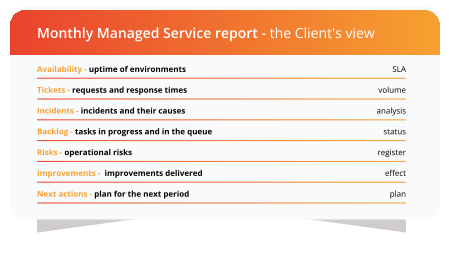
Managed Services should leave the client in no doubt: what is managed, who answers for it, how quality is reported and how results are measured.
What the model includes
We agree the scope and the way of working during setup, before we take the area over.
- A defined scope of responsibility
- A dedicated technical lead approved by the client
- A team of specialists matched to the technology and the workload
- SLAs/KPIs and regular reporting
- A path for escalation and communication
- Operational continuity
- Backup skills
- A backlog of improvements and automation
Staff Augmentation gives you people.
Managed Services gives you accountability for a defined area.
Both models make sense, but they solve different problems. The comparison below helps you choose.
Staff Augmentation
- The client manages the specialist directly
- Best when the client is missing a specific skill
- The client controls tasks, priorities and delivery
- The emphasis falls on skills and team capacity
- Good for projects, sprints and temporary reinforcement
Managed Services
- GS Services manages an agreed scope or team
- Best when the client needs ongoing support and ownership
- Responsibilities, reporting and SLAs/KPIs are agreed up front
- The emphasis falls on stability, continuity and accountable delivery
- Good for maintenance, operations, platforms, cloud and ongoing support

Need accountability,
not just an extra pair of hands?
If your team needs a managed operating model, we will help define the scope, the responsibilities, the SLAs/KPIs and the make-up of the team.
How we launch Managed Services step by step
Setup starts with an operational review, not with naming people. We agree the scope and the metrics before we take the area over.
01.
Discovery and operational review
We analyze the environment, the responsibilities, the problems, the risks and the expected scope.
02.
Defining the scope
We agree what GS Services takes over and what stays with the client.
03.
SLA/KPI
We define the reporting, the metrics, the escalation paths and the quality criteria.
04.
The team and the technical lead
We select the specialists and name a lead the client approves.
05.
Transition and onboarding
We transfer knowledge, document the processes and settle on a rhythm of communication.
06.
Run and improve
We manage the agreed scope, report the results and roll out improvements.
Case studies
Case Studies Carousel
Frequently asked questions about Managed Services
Technical specializations
Specialization Carousel – hello from the saved content!
Want more stability in your IT operations?
Let’s talk about the area that could be managed better, the level of accountability you need, and how working with GS Services would look.